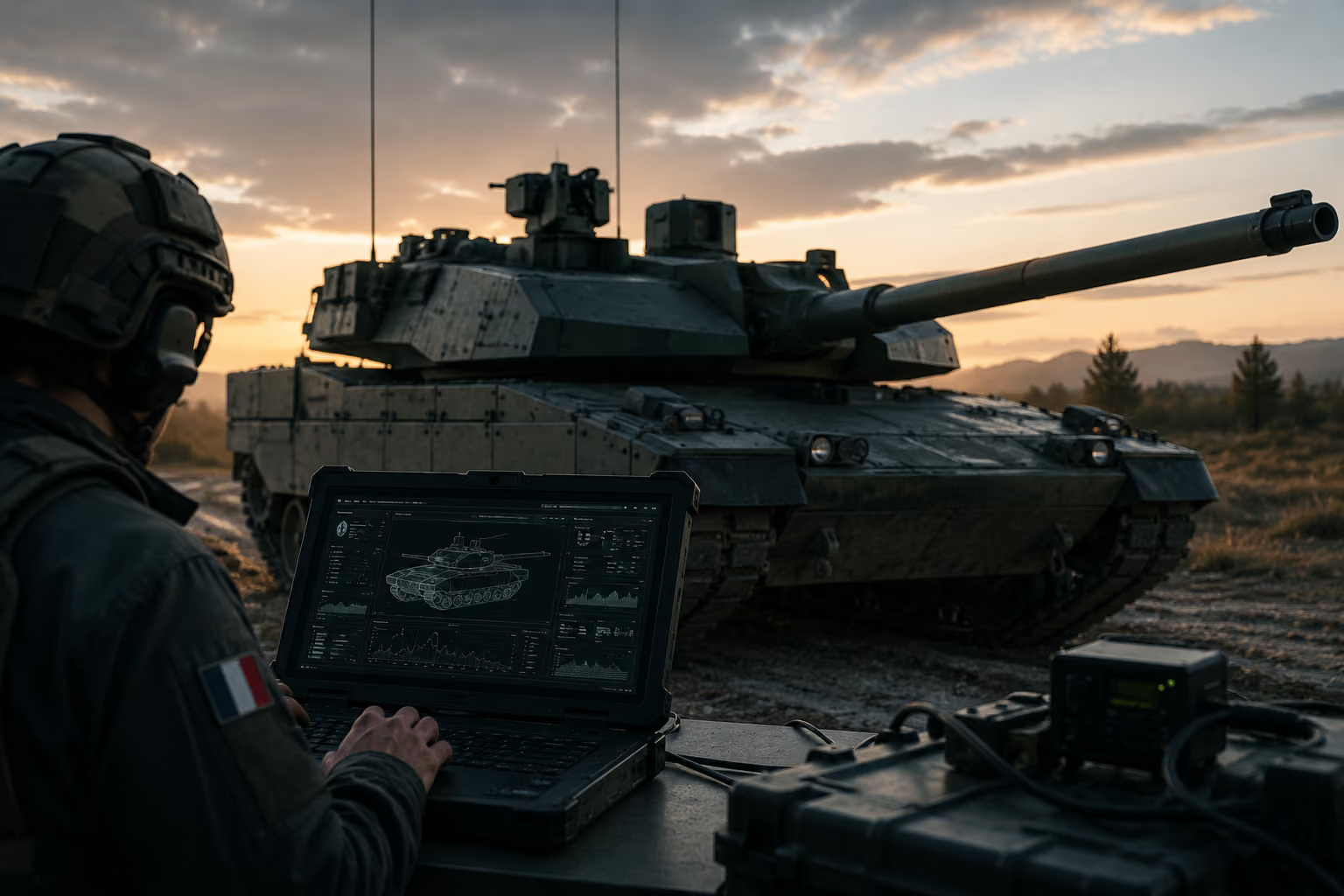
Mastering industrial performance in defence: the key role of AI, from systems to the field

Artificial intelligence is establishing itself as one of the major topics in the defence sector. While operational applications of AI in weapon systems currently command a great deal of attention, its potential extends far beyond this single field.
It also represents a major lever for industrial performance, capable of accelerating design, streamlining production, anticipating maintenance needs, securing supply chains and reducing decision-making times.
In a context of ramping up programmes, supply chain tensions and increasing demands for operational availability, the question is no longer whether AI will find its place in defence.
It is already here.
The challenge now is to identify where it truly creates value and how European manufacturers can leverage it without compromising their technological sovereignty.
AI, a lever for industrial performance across the DITB
In defence, the value of AI does not rely solely on algorithms, but on the ability to exploit data throughout the entire lifecycle of programmes. Design, production, quality, maintenance and support must all be able to rely on consistent and accessible information.
This logic directly addresses the current challenges of the DITB: ramping up production, quality requirements, document control, cost pressure and securing supplies.
Players like Airbus Defence & Space are already using AI to accelerate certain design phases and optimise technical choices. However, the most significant gains often appear in production: automated analysis of non-conformities, monitoring of industrial flows, detection of bottlenecks or document management.
One of the main lessons from projects currently being deployed is that performance depends as much on the flow of information between departments as it does on the quality of the algorithms themselves. It is precisely at these interfaces that agap2 teams intervene, particularly in demanding industrial environments.
Maintenance and supply chain: where operational availability is won or lost
Maintenance in operational condition is arguably one of the areas where the value of AI is most tangible.
Three issues arise systematically: equipment unavailability due to failures detected too late, schedule slippage caused by unforeseen interventions, and pressure on critical parts.
In practice, these difficulties can result in the prolonged immobilisation of equipment while waiting for a component, the saturation of maintenance capacities, or even a temporary drop in fleet availability following a series of recurring incidents.
Predictive maintenance and advanced planning tools make it possible to identify weak signals earlier and direct resources to where they are truly needed.
The same reasoning applies to the supply chain. Defence programmes rely on complex supplier chains, which are often specialised and sometimes weakened by geopolitical or industrial tensions.
A failure in a critical component or a sudden extension in supplier lead times can quickly impact industrial schedules and, by a domino effect, the operational availability of the equipment concerned.
AI is not intended to replace the expertise of procurement, logistics, or industrial teams. Instead, it enables better risk anticipation, makes supply chain vulnerabilities visible, and allows for faster decision-making when tensions arise.
From data to operational decision-making
Weapon systems represent the most visible aspect of the convergence between AI and defence. Embedded data hubs, augmented artillery systems, and drones incorporating advanced analysis capabilities are just a few examples of this growing trend.
But behind these demonstrators lies a reality that is often less visible. The effectiveness of these systems depends above all on the quality of the available data, the robustness of the supporting architectures, and the trust that operators place in them.
An algorithmic recommendation is only valuable if it is understandable, controllable, and adapted to the reality of the mission.
One of the major challenges today concerns the reduction of decision-making latency. Operators must process increasing volumes of data from multiple sensors, platforms, and information systems. The challenge is no longer just accessing information, but quickly identifying what is actually useful for decision-making.
The value of AI therefore lies in its ability to prioritise available information, accelerate analysis, and support decision-making, without ever replacing human responsibility.
Sovereignty: the condition for credible defence AI
Sovereignty is the common thread running through all these transformations.
Defence AI cannot rely long-term on opaque technological building blocks or insufficiently controlled data chains. The issue goes far beyond the subject of cybersecurity alone.
Defence programmes operate within particularly long life cycles. Manufacturers must therefore retain control over their data, models, and development capabilities over several decades.
Excessive dependence on certain external technologies could tomorrow become a factor of vulnerability as much as a brake on industrial performance.
For the European defence industrial and technological base, the challenge is to reconcile technological acceleration with strategic autonomy. The value of AI is not measured solely by its technical performance, but also by its ability to fit sustainably into a controlled, resilient, and sovereign ecosystem.
Conclusion: the real AI battle
From the system to the field, AI is most effective when it helps solve concrete industrial problems: producing more without compromising quality, maintaining equipment availability, securing supplies, and accelerating decision-making.
The real battle for AI in defence is therefore not just being fought on the battlefield. It is also being fought in factories, maintenance workshops, supply chains, and the organisations that connect all these players.
For European manufacturers, the challenge is no longer just to adopt AI, but to integrate it into their entire value chain while preserving their technological sovereignty. This is the condition under which it can become a true lever for industrial and operational performance.