The industry does not have a technology problem. It has a convergence problem.

EXPERT INSIGHT · IT FOR INDUSTRY
The industry does not have a technology problem. It has a convergence problem.
In the industrial world, we have been talking about digital transformation, the factory of the future, and Industry 4.0 for over a decade. Yet, many companies still notice a gap between the initial promises and the actual benefits achieved: projects that are difficult to scale, underutilised data, tools that teams struggle to adopt, or economic gains that are hard to quantify.
The problem does not necessarily lie in a lack of technology. Today’s industry has an abundance of solutions: IoT, artificial intelligence, embedded software, data platforms, automation, and more. The real challenge lies elsewhere: creating coherence between these building blocks, existing systems, and the realities on the ground.
We are speaking with Hervé Le Duff, Global Chief Architect at agap2IT. His conviction is clear: the industrial performance of tomorrow will be determined less by the accumulation of innovations and more by the ability to converge IT, OT, and business functions.
1. Why do transformation projects not always deliver on their promises?
The first trap is evaluating a transformation project solely through the lens of immediate functional or financial gain. However, a significant portion of digital investment is primarily aimed at addressing technical debt and reducing risk.
Modernising ageing infrastructure, securing data exchanges, or replacing obsolete technology does not necessarily produce a visible benefit overnight. However, these actions limit incidents, production downtime, maintenance cost overruns, and vulnerabilities that can weigh heavily on a company in the long term. In the most critical situations, the consequences can be human, environmental, or even geostrategic.
When a company addresses its technical debt, it does not always see an immediate economic gain. It is often reducing a risk that was not, or was poorly, valued in its key performance indicators.
Beyond this risk reduction, difficulties frequently stem from a lack of a global vision. Projects follow one another, sometimes driven by technological opportunities, without always being designed for continuity with existing systems or integrated into a shared roadmap. Silos persist between IT teams, operations, engineering, production, and management functions.
2. The industry is becoming a system with an increasingly software-centric centre of gravity
In recent years, the transformation of the industry has accelerated due to several developments: the rise of cybersecurity, the proliferation of data from equipment, the widespread use of embedded software, and increasing traceability requirements and regulatory constraints.
In many sectors, production challenges have also become more intense. Aerospace, shipbuilding, defence, and energy must all cope with significant order books, the need to increase production rates, and more distributed value chains.
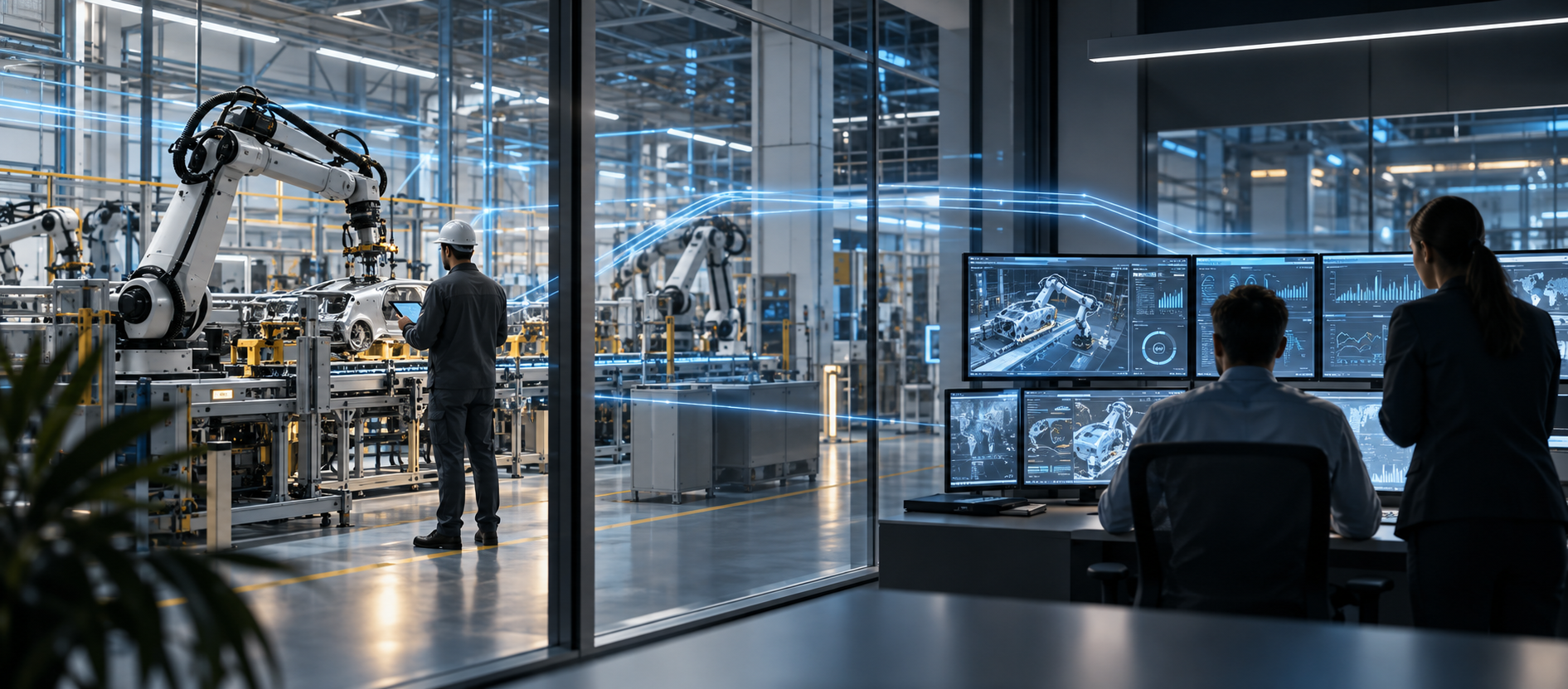
This reality requires enhanced connectivity between design, manufacturing, the supply chain, management tools, maintenance, and after-sales service. The factory can no longer be considered an isolated environment: it is becoming a component of a much broader software-centric information system where the goal is not only to produce more, but also to preserve the capacity for innovation, circulate feedback from the field, and prepare the products of tomorrow, without pitting operational urgency against a long-term vision.
3. The real challenge is architectural
Architecture does not just refer to a technical solution. It is the ability to design a coherent whole, in which tools, data, and processes work together to serve an industrial objective.
It is this coherence that allows data to flow seamlessly between the field and management functions, avoids re-entry, makes decisions more reliable, and ensures systems are truly scalable.
The value of a system is not found in the accumulation of technological solutions—no matter how innovative they may be—but in their ability to complement one another, communicate, and ensure continuity of data and processes.
The analogy is simple: installing racing wheels on a car with an unsuitable chassis, engine, and transmission does not create performance. The investment is real, but the overall value remains limited.
The same applies to the industrial sector. Adding sensors, an IoT platform, or an AI solution without rethinking their place in the existing ecosystem often leads to a proliferation of interfaces, fragmented workflows, and hidden costs. Conversely, a solid architecture transforms every technological building block into a lever for collective performance.
4. The mistake: prioritising the visible over the structural
One of the most common mistakes is being seduced by flashy use cases that are poorly suited to real-world production conditions.
A tool may seem innovative without being useful. For example, a conversational assistant deployed on a production line might seem relevant in theory. But in a noisy environment, with operators wearing protective gear and working to strict production schedules, its use can quickly become impractical.
The risk is then launching prototypes that never scale or are abandoned due to a lack of adoption.
Therefore, the point is not to reject innovation. The point is not to confuse technological novelty with value creation.
The real work is often less visible: urbanising systems, ensuring data continuity, eliminating process gaps, reducing manual data entry, and making reference data more reliable. These tasks require more effort, but they create lasting benefits.
5. AI: a powerful building block, not a starting point
Artificial intelligence opens up concrete prospects for the industry. It is already used in quality control via image analysis, anomaly detection, facility supervision, and predictive maintenance.
Thanks to sensors and data processing, manufacturers can identify weak signals, anticipate certain failures, and intervene exactly where the need arises. These applications help reduce unplanned downtime, optimise equipment lifecycles, and increase the availability of production resources.
But AI does not replace a flawed architecture. Without reliable data, consistent processes, and the ability to integrate it into the existing environment, it cannot be industrialised sustainably and risks quickly becoming a gimmick.
To deploy AI, companies must therefore ensure the quality of their data, the robustness of their software, the explainability of their models, and their compatibility with cybersecurity and regulatory constraints. The challenge is not to add AI everywhere, but to use it where it meets a real industrial need.
6. The agap2IT response: breaking down silos
Faced with this complexity and the need for an architectural mindset, agap2IT supports manufacturers by bringing together skills that are too often separated: management IT, industrial IT, embedded systems, and business expertise.
This approach makes it possible to move beyond the divide between IT and OT. The challenges lie neither exclusively in information systems nor exclusively on the shop floor: they lie in how they connect.
We bring together IT, industrial, and embedded expertise, and the proximity this creates generates an essential synergy for designing coherent architectures and avoiding silos.
Expertise in industrial processes is decisive in this strategy. Understanding manufacturing, production rate constraints, quality requirements and associated standards, operator usage, and maintenance realities allows for the design of solutions that are truly adapted to needs.
The added value of agap2IT thus lies in its ability to combine business expertise, technological mastery, and an architectural vision, while drawing on concrete feedback from the difficulties encountered by manufacturers. In practical terms, this approach begins with an analysis of critical processes, workflows, and dependencies, in order to identify priorities and then build a realistic, sequenced, and measurable trajectory. The goal is not to deploy more tools, but to secure their integration and adoption over the long term.
IN SUMMARY
Succeeding in an industrial transformation is therefore not about choosing a technology first, but about building a trajectory. This must start from industrial objectives, take into account what already exists, and evolve systems, data, processes, and skills in a coherent manner.
It cannot be the result of a series of POCs or low-cost micro-projects designed independently of one another: even if successful in isolation, these initiatives would likely produce successive bursts of excitement, but little impact on overall performance.
In an industry where the centre of gravity is increasingly shifting towards software, performance will not come from stacking innovations, but from embedding them within a common architecture and trajectory, ensuring they work together to deliver lasting value for operations.